Our processing route is heap leaching — the cheapest and most environmentally safe gold-recovery technology available. The system runs as a closed loop: water and reagents stay inside the circuit, with only modest top-up needed to compensate for evaporation.
Our processing method is heap leaching. Heap leach is the cheapest and most environmentally safe technology for gold recovery. The entire circuit runs as a closed loop: water and materials do not leave the system, although a small make-up flow has to be added from outside to compensate for evaporation.
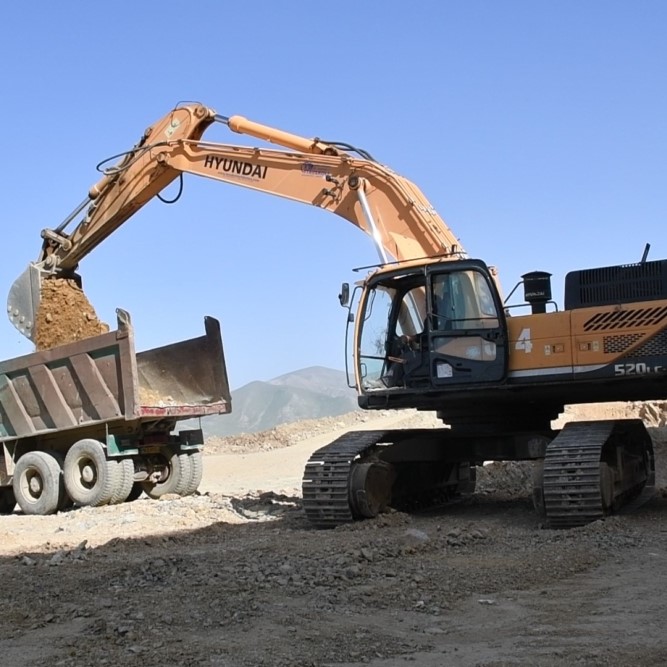
When constructing a heap leach site, the topsoil and humus layer — which is suitable for agriculture — is first removed according to the facility plan and stockpiled in a dedicated area, to be used later for site rehabilitation.
Site preparation stages: - Levelling the ground (cut and fill) approximately horizontally, with appropriate slopes of around 5% towards the solution ponds for drainage, in line with the facility and topographic plans. - Sub-base earthworks and removal of large rocks. - Spreading sand over the site, creating a 20-cm sand layer as additional protection for the geomembrane. - Lining the site with a high-strength geomembrane 1.5 to 2.5 mm thick, followed by leak-detection testing. - Building the pipe network with high-pressure pipes between the heap leach field and the ponds. - Transporting and stacking the prepared ore onto the heap.
It is worth noting that all extracted and crushed ore is stacked on the heap as a pile. Bench thickness is 8–10 metres and there are 2 to 3 benches. After the ore reserve is exhausted, the piles remain in place and treatment and rehabilitation are carried out on site.